

Need Help? Give Us a Call.

When your guests step off the beach or out of a muddy hiking trail, they want one thing: a quick way to rinse off. A shower tower gives them exactly that—without the space requirements or plumbing complexity of a full shower. But choosing the right one means understanding what these fixtures do, where they work best, and which materials will survive your climate.
Let's walk through what matters most when you're shopping for a commercial shower tower.


Here's the confusion that trips up most buyers: shower panels and shower towers get lumped into the same category online, but they're built for completely different purposes.
Shower panels are personal, residential fixtures. They're the sleek multi-button units you install in a bathroom or spa shower, designed for full showers with adjustable sprays, body jets, and temperature controls. They're aesthetic-focused and built for individual use.
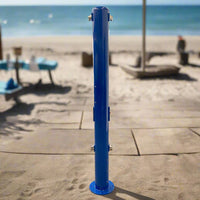
Commercial shower towers are the opposite. They're heavy-duty outdoor fixtures designed for quick rinses—not full showers. You'll find them at beaches where people need to wash sand off, at hiking trail parking areas, at adventure parks where guests get muddy on 4-wheeler trails, or at any public space where people need a few minutes of water to freshen up before heading home.
The versatility factor: What makes shower towers interesting is their customization. Many models come with add-ons like:
This means a single tower can serve multiple purposes depending on your facility's needs. You're not locked into one function.

This is the biggest decision you'll make, and it comes down to one principle: location, location, location.
Carbon steel is stronger and less expensive than stainless steel. But it rusts when exposed to moisture and oxygen. Stainless steel contains at least 10.5% chromium, which forms an invisible protective layer that resists corrosion. As Innovatech Labs explains, this chromium oxide barrier is what makes stainless steel ideal for outdoor environments.

If you're near the ocean, the decision is simple: use stainless steel. Period.
Saltwater and salt-laden air are brutal on carbon steel. Even coated or painted carbon steel will rust within a few years in a coastal environment. According to Dahlstrom Roll Form, bare carbon steel can be over 8,000 times more prone to corrosion than 316 stainless steel in these conditions.
Stainless steel (especially Grade 316, which includes molybdenum) stands up to salt spray and chlorides in the air for decades with minimal maintenance. If you're installing at a beach facility, you'll want a unit with a stainless steel construction option such as the Stern-Williams 6200 Outdoor Shower Tower with Foot Wash to handle the salt spray exposure year-round.

If you're inland and not in a salt-spray environment, carbon steel with proper protective coatings can work—but stainless is still the safer choice for long-term value.
Carbon Steel Pros:
Carbon Steel Cons:
Stainless Steel Pros:
Stainless Steel Cons:
The math is simple: pay more upfront for stainless, or pay less upfront and replace your tower multiple times.

If you're installing a tower at a popular beach or busy park, think about customization differently.
Most property managers assume they need multiple separate shower towers for high-traffic areas. But you don't. You need one tower, heavily customized.

Instead of installing two separate towers, you can install one with two shower heads. Instead of three towers, get one with four shower heads all on the same unit like Willoughby's Quad Shower Tower. This approach works exceptionally well for facilities handling hundreds of daily users.
Here's why this matters:
Cost savings: You're paying for one infrastructure installation, one foundation, one plumbing connection.
Space efficiency: One tower occupies less space than three separate units.
Maintenance: One piece of equipment to maintain rather than three.
Durability: Multiple fixtures on one tower distribute the load better than individual units crammed together.
If you're building a facility that handles hundreds of people per day, talk to your supplier about maximum customization options. You can stack features without stacking equipment costs.
Beyond the coast, climate impacts material durability in different ways.
We already covered this: stainless steel, preferably Grade 316 with molybdenum. Salt is carried inland by wind, fog, and rain. POLYTOPS shows that salt can travel as far as 27 miles inland from the shore, depending on weather patterns and geography.
If you're within 10 miles of the coast, assume salt spray is a factor.

Heat doesn't cause corrosion the way salt does, but it accelerates other problems.
Extreme temperature swings between day and night cause metals to expand and contract repeatedly. Over months and years, this weakens fixtures and can cause leaks or cracks in outdoor piping. Hard water is common in desert areas, which adds mineral buildup and speeds up corrosion. Direct sun exposure degrades seals, rubber washers, and fittings faster than in moderate climates. Thompson Family Plumbing explains why desert installations require extra attention to material selection and maintenance.
For desert installations, insulate any exposed pipes and consider UV-resistant materials. Stainless steel still outperforms carbon steel, and maintenance becomes more important.
High humidity (non-salt environments) requires corrosion-resistant materials but less extreme than coastal salt spray. Carbon steel with proper coatings can work, though stainless is still preferred.
Intense UV exposure (high-altitude or desert locations) degrades paint and protective coatings faster, making maintenance coatings more frequent and expensive.
Commercial shower towers at public facilities need to meet ADA accessibility standards. Here's what matters:

Grab bars and support: If you're installing ADA-compliant units, they'll come with grab bars at specific heights (typically 33-36 inches from the floor on horizontal bars) to assist users with balance and mobility. According to The U.S. Access Board, these measurements are designed to accommodate a wide range of mobility needs.
Clear floor space: The area in front of the tower must be clear enough for wheelchair approach and access—typically 36 inches wide by 48 inches deep minimum.
Accessible controls: Water controls and spray units must be reachable and operable with one hand, without requiring tight gripping or twisting. This means no overly stiff valves.
Low threshold: If there's any curb or lip at the base, it shouldn't exceed ½ inch—beveled if possible—to prevent tripping or wheelchair obstruction.
Many commercial shower tower suppliers offer ADA-compliant versions with reinforced walls ready for grab bar installation. There are ADA-compliant shower tower models with handlebars/accessibility features like the Stern-Williams 6800 ADA All-Purpose Outdoor Shower Tower with Side Grab Bar. It's worth asking about this upfront rather than retrofitting later, which costs more.
Before ordering a shower tower, understand what you're getting into.

Installation depth: Most towers require a concrete foundation or pedestal. Plan for 2-3 feet of clearance around the base for maintenance access.
Water supply: You'll need an accessible water line with adequate pressure (typically 40-60 PSI for outdoor fixtures). Talk to your plumber about where the connection point can be.
Drainage: The rinse water has to go somewhere. Most facilities use gravel drainage areas or connect to existing storm drains. Understand local drainage codes before installing.
Seasonal considerations: In freezing climates, you may need to drain the lines before winter or install freeze-protection valves. Desert climates need UV-resistant insulation on exposed pipes.
Maintenance access: Leave room to work on the fixture. You'll need to occasionally replace washers, seals, or internal parts.
Your facility's location, traffic volume, and climate determine which shower tower will last and perform best. Stainless steel costs more upfront but saves money over time in coastal and harsh environments. Customization through multiple heads and add-ons means you don't need multiple units for high-traffic areas.
Our team can walk you through every specification and help you choose the right materials and configuration for your specific climate and use case.
Call Us: (833) 746-7688 Join Our Email List
Want more practical facility management insights? Join our community for exclusive guides and tips delivered to your inbox. We share real-world advice for property managers and facility owners just like you.





Leave a comment
Leave a comment
Log in or create an account to leave a comment.