

Need Help? Give Us a Call.

A commercial grade swing bench is built around three things a residential porch swing never has: a welded galvanized steel frame anchored in concrete, a coated steel seat rated for constant public use, and hardware engineered to survive weather, vandalism, and thousands of swing cycles without supervision. That is the difference between seating that lasts decades in a park and a porch swing that fails in its first season outdoors.
If you manage a park, HOA common area, senior living community, or campus courtyard, you have probably noticed swing seating showing up on resident wish lists. People love it. But nearly everything sold online as an outdoor swing bench is built for a covered porch and a single family, not a public space. Here is what actually separates commercial equipment from the residential lookalikes, so you can buy once and be done with it.
A porch swing assumes a roof over it, gentle use, and an owner who notices the first loose bolt. A public swing bench gets full sun and rain, users of every size, kids standing on the seat, and nobody reporting wear until something breaks. When it breaks, it is your liability, not the manufacturer's.
The failure is predictable because the engineering assumptions break immediately. An unanchored A-frame tips when teenagers test it, migrates across the plaza, or disappears entirely. Wood seats splinter, fade, and carve easily. Rope and light chain rated for gentle porch duty give out under hundreds of users a week, and a single failed connection point drops someone to the ground.
| Residential Porch Swing vs. Commercial Swing Bench: Key Differences | ||
| Feature | Residential Porch Swing | Commercial Swing Bench |
|---|---|---|
| Frame | None, or an unanchored A-frame stand | Freestanding 2-3/8" OD pre-galvanized steel frame |
| Anchoring | Ceiling hooks or ground weight | In-ground posts set in 18" concrete footings |
| Seat | Wood, wicker, or fabric sling | 11 or 12-gauge coated steel |
| Suspension | Rope or light chain, two points | Dual-chain system with stabilizing chains, four connection points |
| Weather exposure | Assumes a covered porch | Rated for full sun, rain, and salt exposure |
| Warranty context | Residential use; public installation voids most warranties | 5 to 7-year commercial coating warranties |
The warranty row deserves a second look. Most residential furniture warranties end the moment the product is installed in a commercial or public setting. If a porch swing fails in your park, you own the injury claim and the replacement cost with no manufacturer standing behind you. That replacement cycle is the hidden math that makes a $400 swing more expensive than a $2,000 one.
Anchoring is the single clearest dividing line between residential and commercial swing seating. A commercial unit like the MyTCoat Park Swing Bench arrives as a complete freestanding structure with a 2-3/8" outside-diameter pre-galvanized steel frame, and its posts get set into concrete footings 18 inches deep. Once that concrete cures, which takes 2 to 3 days, the frame cannot tip, walk, or leave with someone's truck.
That permanence solves three problems at once. It eliminates theft of a $2,000+ asset from an unsupervised space. It provides the stability to handle adults actually swinging, not just sitting. And it satisfies the engineered-mounting expectations that insurers and risk managers look for when they evaluate liability on public seating.
The suspension matters just as much as the footing. A dual-chain system pairs 48" primary chains with 24" stabilizing chains, spreading load across multiple connection points with swing hangers positioned 74 inches apart. The stabilizing chains are the detail residential swings skip: they limit side-to-side motion, which is both the comfort feature that keeps the ride smooth and the safety feature that keeps the motion predictable. The hardware is Xylan-coated for corrosion resistance beyond standard galvanized bolts.

In-ground commercial swing bench in 4' and 6' lengths with three seat styles and three coating systems, backed by warranties up to 7 years.
Commercial swing benches use coated steel seats in three main patterns, and the choice is more practical than aesthetic. Expanded metal (3/4" #9 flattened) drains instantly and cleans easily. Punched steel (12-gauge with 1/2" holes) offers a more solid surface while still shedding water. Slatted steel (11-gauge) gives the traditional bench appearance with the most comfort for longer sits.
The coating is where the long-term math gets decided. On steel furniture the coating is not cosmetic. It is the corrosion barrier, the graffiti defense, and the reason the seat does not burn legs in July sun the way bare metal does.
MyTCoat offers three systems on this bench. The Industry Standard polyethylene coating carries a 5-year warranty in 9 colors and is the proven budget option. The Advantage coating is MyTCoat's proprietary thermoplastic with a 7-year warranty, 90% gloss retention, and a non-porous surface that resists stains, mold, acids, and salt, which makes it the right call for coastal or high-abuse locations. The Textured coating also carries a 7-year warranty and adds grip while concealing minor wear in high-traffic installs. As MyTCoat explains in its coating documentation, its thermoplastic system bonds to heat-treated steel at an adhesion level plastisol and polyethylene cannot match, without the PVC and phthalate concerns that come with plastisol.
Color earns one practical note here. The Advantage system comes in 13 colors, and in full southern sun a lighter seat runs meaningfully cooler than a dark one. If your installation bakes all afternoon, pick the color for surface temperature first and branding second.
A swing bench is moving equipment, and moving equipment has placement rules that fixed benches do not. The CPSC Public Playground Safety Handbook recommends locating swinging equipment toward a corner, side, or edge of an activity area with the zone in front of and behind the swing kept clear. That guidance is written for playgrounds, but the physics does not care about the user's age: keep the swing arc out of walkways and leave open space fore and aft.
The MyTCoat unit stands 98 inches tall on a 96-inch frame with 18 inches of ground clearance under the seat, so a practical plan reserves a clear rectangle several feet beyond the frame in the swing direction. Placements that consistently work: along a walking path facing a view, at the edge of a courtyard, beside a pond or garden feature, and in senior living common areas where gentle motion is genuinely popular with residents.
Accessibility planning belongs in the same conversation. Under the U.S. Access Board's outdoor developed areas guidance, where benches are provided, at least 20 percent and never fewer than one of each type must meet the accessibility specs, including a 17 to 19-inch seat height and an adjacent 30" x 48" firm, stable clear space so a wheelchair user can sit beside a companion. A swing bench naturally moves, so the practical approach is to pair it with fixed accessible seating on the same pad rather than treating the swing as your accessible element.
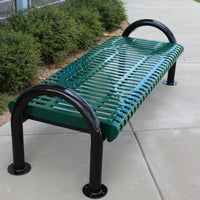
If site constraints rule out the clearance a swing needs, a fixed bench from the same product family keeps the look consistent. The MyTCoat Metal Downtown Park Bench with Back uses the same coating systems and mounts flush to a pad with no swing zone required.

The same commercial coatings in a fixed bench for tight placements where a swing zone will not fit.
Less than most managers expect, but not zero, and the difference between the two is documented inspection. Chains and hardware connections should be inspected annually: check the links and hangers for wear, confirm the Xylan-coated bolts are tight, and verify the swing motion still feels controlled. Ten minutes a year, logged, is also exactly the paper trail you want if a liability question ever comes up.
The coating needs nothing beyond an occasional wash. Non-porous thermoplastic does not absorb stains and never needs repainting, sanding, or sealing, which is the recurring cost that quietly eats budgets on wood and painted-metal seating. Over a 15 to 20-year service life, the maintenance gap between coated commercial steel and residential materials usually ends up larger than the purchase price gap.
Expect roughly $1,800 to $3,400 depending on length, seat style, and coating. The MyTCoat Park Swing Bench runs from $1,807 for a 4-foot expanded metal seat with the Industry Standard coating to $3,311 for a 6-foot slatted seat with the Advantage coating, and every configuration ships free from Supply-A-City.
You can, but you should not. Residential swings are not engineered or warrantied for public use, most warranties are void in commercial settings, and an unanchored swing in an unsupervised space is a theft and liability problem. Commercial units are anchored in concrete and rated for constant public use.
The 4-foot model seats 2 to 3 people on a 48-inch seat, and the 6-foot model seats 3 to 4 on a 72-inch seat. Both use the same 96-inch frame and 98-inch overall height.
Posts are set in concrete footings 18 inches deep, and the concrete needs 2 to 3 days to cure before use. Professional installation is required for the foundation work, both for swing performance and to meet the commercial safety standards your insurer expects. Hardware and instructions ship with the bench.
Keep the area in front of and behind the swing path clear and place the unit toward the edge of an activity area rather than in the middle of foot traffic, consistent with CPSC guidance for moving equipment. Plan several feet of open space beyond the 96-inch frame in the swing direction.
Swing seating is one of the few site furnishings residents actively request, and it earns its place everywhere from parks to HOA courtyards, campuses, and senior living communities. It also pairs naturally with the fixed seating in our commercial park bench collection when you're planning a full seating area. Buy it commercial grade once and it will outlast three rounds of residential replacements.
Whether you need a quote for multiple units, help choosing between coatings, or installation guidance for your site, we're here to help.
Call Us: (833) 746-7688 Email Us: Info@Supplyacity.com Join Our Email List
Authorized distributor · USA-manufactured · Free shipping · Financing available · 30-day money-back guarantee
Want more practical facility management insights? Join our community for real-world guides and tips for property managers and facility owners, delivered to your inbox.




Leave a comment
Leave a comment
Log in or create an account to leave a comment.